
In 2026, online learning platforms will be smarter and more data-driven. But beneath all this progress lies a hidden challenge, such as class imbalance, that can quietly mislead predictions, overlook struggling learners, and reduce the effectiveness of personalization. Most LMS systems naturally focus on the majority of students who stay active and perform well, while unintentionally sidelining the smaller group that needs the most support.
In this blog, we’ll break down what class imbalance really means in online education and how to detect it using simple metrics like class counts, visual charts, ratios, and performance scores. In short, we will provide tips to Solve Online Class Imbalance Issues.
By the end, you’ll understand how these techniques can help LMS platforms create a more balanced, supportive, and genuinely personalized learning experience for every student, not just the majority of students.
What Is Class Imbalance?
Class Imbalance occurs when a dataset has more examples of the majority class than of the minority class. For example, imagine you have 1,000 students who have passed a test, but in your class, only 30 have failed. Because one group is much larger, the computer learns more about the bigger group and less about the smaller one.
Class imbalance in machine learning is common and becomes a problem because the model starts to think that a higher number of students answer correctly. So it may predict pass for almost everyone, even when the student is struggling.
Why Class Imbalance Is a Problem for Students?
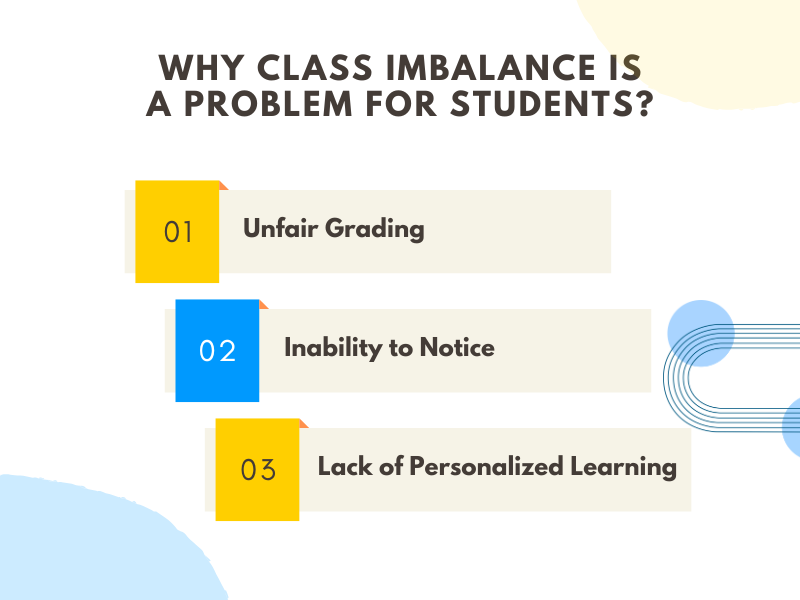
Unfair Grading
Class imbalance can lead to unfair grading in automated systems, as they are subject to rules and regulations. This further results in marking the answers incorrect if you follow a different pattern for answering. The pain point is that if you don’t follow the rules properly, your answer will still be marked incorrect, even if it’s correct. This results in poor grades.
Inability to Notice
Sometimes we observe that a single dataset has too many examples for a single group, such as students who have passed the class. But on the other hand, there are a few examples of another minor group, such as students who have failed. Due to this uneven data, the system learns more about the bigger group and becomes unfair or biased towards it. Lastly, the system may assume that most students are doing well and fail to notice when a student needs help.
Lack of Personalized Learning
Struggling students may not get the support or guidance they need at the right time. This also affects personalized learning, as the system may not correctly identify whether a student needs an easier lesson or is ready for more advanced work.
This problem can overall hurt learning progress, confidence, and academic performance. This may also increase the dropout rate, as students who need help the most are often overlooked.
How Class Imbalance Hurts LMS Performance?
In online learning, not all students behave the same way. Some students stay active and score well, while others struggle or drop out. which is why students need to pay someone to do my online class pricing. Modern LMSs are increasingly integrating Artificial Intelligence and Machine Learning to add more features such as personalization, automation, and data analysis. It may sometimes lead to class imbalance and result in unfair or inaccurate decisions. In this section, we will discuss how it hampers the fairness in machine learning.
Early-warning Systems Fail to Spot Struggling Students
An LMS sees data from “doing well” students; hence, it assumes everyone is fine. It creates difficulties for students who actually need help and may not be flagged early, even though they are answering without understanding.
Therefore, this causes delays in support, a higher dropout risk, and also fails at predicting real student performance. That’s why, in the battle between online class help vs AI tutors, professionals can help bridge the learning gap for struggling students.
Course Recommendations Become Less Personalized
The course recommendation system follows the majority of students. So they end up suggesting the same popular courses. Therefore, it ignores students with unique interests or learning paths. Furthermore, this results in generic, less effective suggestions.
LMS Misses Signs of Academic Struggle
When only a small number of students show difficulty, the LMS can’t learn their patterns well. In addition, this causes the system to overlook real warning signs. This results in many students being left without the help they need.
Engagement Levels Get Misinterpreted
If most students log in daily or finish assignments on time, the LMS will mark them active. But students who study late at night or have jobs may be marked as inactive, even if they’re trying their best.
Real Life Examples
Now that we have discussed the problem of class imbalance, let’s look at some real-life examples. You may relate to this section especially if you struggle to understand the instructions of automated grading or LMS.
- One example we can take is Pearson MyLab. This LMS platform can be problematic for students who use alternative methods, as their answers may be marked as incorrect because their styles are not presented in the training data.
- Another example: manual grading combined with Turnitin can introduce class imbalance, as it sometimes flags simple writing.
- Freehand Grader assignments can also create bias if the unique answering styles of a student don’t match the standard patterns instructors expect.
- Proctoring systems like Respondus Monitor may further contribute to class imbalance, as their video and motion-detection algorithms work best in stable environments and may flag students who do not have proper systems or who stay in shared spaces.
Top 6 Tips to Solve Online Class Imbalance Issues
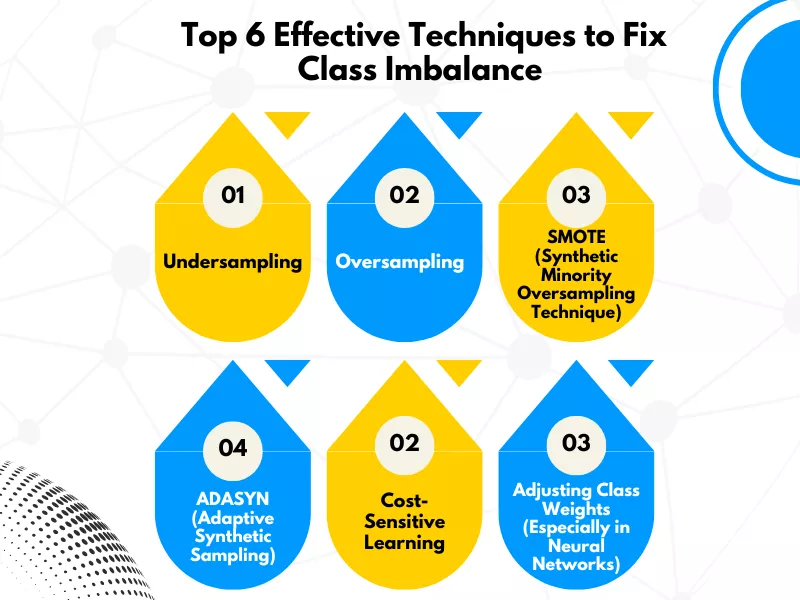
Undersampling
Oversampling and undersampling for online classes are among the best ways to fix. In undersampling, we reduce the number of examples in the majority class to match the number in the minority class. This will help create a more balanced dataset quickly.
Oversampling
On the other hand, oversampling works in the opposite direction; instead of reducing data, it duplicates or repeats examples from the minority class to make the sample size more similar to that of the majority class.
SMOTE (Synthetic Minority Oversampling Technique)
SMOTE is a more effective form of oversampling. Instead of copying the same samples, SMOTE creates new, similar samples for the minority class. This helps the model learn more effectively and reduces the risk of overfitting.
ADASYN (Adaptive Synthetic Sampling)
ADASYN is similar to SMOTE, but it focuses more on generating new training samples from data that is harder to learn from. It helps the model focus on important but underrepresented areas of the dataset.
Cost-Sensitive Learning
Instead of changing the data, this method changes the training process. The model is told to give more weight to the minority class by assigning a higher cost to misclassifications. This also encourages the model to pay more attention to the minority group.
Adjusting Class Weights (Especially in Neural Networks)
In neural networks, we can directly change the class weights in the loss function. This means the model will penalize mistakes on the minority class more, helping it learn to correctly identify those examples.
How to Detect Class Imbalance?
Check Class Counts
This is one of the best techniques to fix online class imbalance. The first thing we can do is check how many students are in each group. For example, if 90% of students pass and only 10% fail, it means one group is much bigger than the other.
Use Visual Charts
Using visuals is an easy way to spot imbalance in class. We can make simple bar charts to see how many students are in each group. If one bar is much taller than the others, it means that group has more students than the others. This helps us quickly see that one group is much larger and dominates the data.
Calculate the Ratio
Another way to check for class imbalance is to compare the sizes of the smaller and larger groups. For example, if for every 1 student who fails, 9 students pass, we say the ratio is 1:9. This means the smaller group is much smaller than the larger one. The smaller the ratio, the bigger the imbalance.
Check Model Performance for Each Class
Sometimes the system might appear to be working well because it shows high overall accuracy, but it might make mistakes for certain students, especially those in smaller groups. To check, we look at precision, recall, and F1 Score for each group separately, rather than just total accuracy. If the model performs poorly on the smaller group, it means the imbalance is causing a problem, and the system is not predicting daily for those students.
Apply Techniques if Needed
If we find that the data is imbalanced, we can use methods like SMOTE and ADASYN to add more examples to the smaller group. These techniques help create new, similar examples, ensuring both groups have equal amounts of data. When the data is more balanced, the model can learn more fairly and better understand all types of students.
Are you a student struggling to find tips for managing class imbalance? Then go for the next section :
Why Choose DoMyOnlineClass123?
- Struggling with LMS platforms? Connect our Online class experts who can understand the learning gap in a better way.
- Our professionals can manage your LMS with their expertise, and you can get good marks while learning as well.
- Whether it’s 3 am or 3 pm, you can get help from our support team. Use our live chat support now to learn.
- Our experts are experienced with various learning management systems Pear Assessment, Canvas, Proctorio, MyMathLab, MathXL, MyStatLab, MyEconLab, Aplia, and so on.
- You can expect full support in the LMS system and imbalance issue resolution at a reasonable rate from DoMyOnlineClass123.
Key Takeaways
Class imbalance may seem like a small issue, but it can have a big impact on learning outcomes. When models focus only on students who are doing well, those who need help can go unnoticed. This can lead to frustration, lower confidence, and even a higher dropout rate.
By detecting and correcting class imbalance, we ensure that the learning system becomes fair, supportive, and more accurate. Using strategies for an unbalanced class can help every student get the right guidance, whether that’s extra help or more advanced challenges.
Frequently Asked Questions
What is a good ratio for class imbalance?
A ratio close to 1:1 is ideal, but in practice, anything up to 1:3 or 1:4 is manageable. Ratios exceeding 1:10 are considered highly imbalanced and often require resampling or algorithmic adjustments.
Which performance metrics should I use when classes are imbalanced?
Use precision, recall, F1 score, and AUC-ROC instead of overall accuracy. These metrics focus on how well the model predicts the minority class, which is crucial when the data is imbalanced.
When should I collect more data rather than use resampling to address class imbalance?
Collecting more real-world data when resampling could introduce bias or overfitting. More authentic examples of minority classes help the model learn real patterns rather than synthetic ones.
Can class imbalance be fixed just by using ensemble methods or deep learning?
Ensemble methods (such as Random Forests or XGBoost) and deep learning can reduce the effects of imbalance, but they work best when combined with resampling, class weighting, or data augmentation. Alone, they may not fully solve the severe imbalance.
Does a model always fail when there is class imbalance?
No. Models can still perform well if metrics focus on minority-class performance and techniques such as resampling, class weighting, or cost-sensitive learning are applied. Overall accuracy alone may be misleading.
What are the risks and downsides of oversampling and undersampling?
Oversampling can lead to overfitting, especially if the data is duplicated. Undersampling may discard valuable information from the majority class. Both should be used carefully with proper validation.

Want To See My Profile — Check Now
- Online Class Help Costs by Subject and Level (2026 Guide) - February 19, 2026
- How to Get WileyPLUS Physics Answers? - February 11, 2026
- WeBWorK Homework Help: Survival Guide, Syntax Tips, and Answers - February 5, 2026